02 September 2025
What are Interchain Accounts?
What are Interchain Accounts?


Eda Akturk
Summary
Learn about Interchain Accounts and the new applications they unlock for developers.
Cross-chain applications often want to do more than send tokens or messages. To do this, they need smart contracts on one chain to directly control accounts on other chains in order to make arbitrary function calls there. This means apps can make swaps, interact with DeFi protocols or execute governance votes as if they were operating locally.
Interchain Accounts (ICAs) make this possible. An ICA is essentially a remote wallet that your contract controls. When your contract on Chain A needs to do something on Chain B, it doesn't just send tokens or messages, instead it executes functions through its dedicated account on Chain B.
This changes how we build cross-chain applications. Instead of resource-intensive workarounds, fragmented integrations, and multiple moving parts when working with different chains, ICAs give you ready-to-use accounts on remote chains that can call any contract.
In this post, we’ll dig into how ICAs work, why they’re a critical building block for cross-chain applications, and how projects like Superswaps are already using them to deliver one-click cross-chain swaps.
What ICAs unlock
Before we get into the weeds, let's look at what this direct cross-chain control makes possible. ICAs open up use cases that were previously complex or resource-intensive:
- Cross-chain single click swaps: A user wants to swap tokens on one chain for another chain’s asset. Tokens are bridged, and the ICA on the destination chain executes the swap on a local DEX, like in Superswaps.
- Cross-chain governance: A DAO requires an NFT to vote. The NFT is bridged to the governance chain, and the ICA there executes the vote once the transfer is complete.
- Bridging collateral: A protocol moves assets from an L2 to an L1 vault. The ICA on the L1 then interacts with the vault to lock the collateral.
- Faster rollup withdrawals: While a user waits for a rollup bridge to finalize, an ICA can claim liquidity instantly on the destination chain, making the UX smoother.
How Interchain Accounts Work
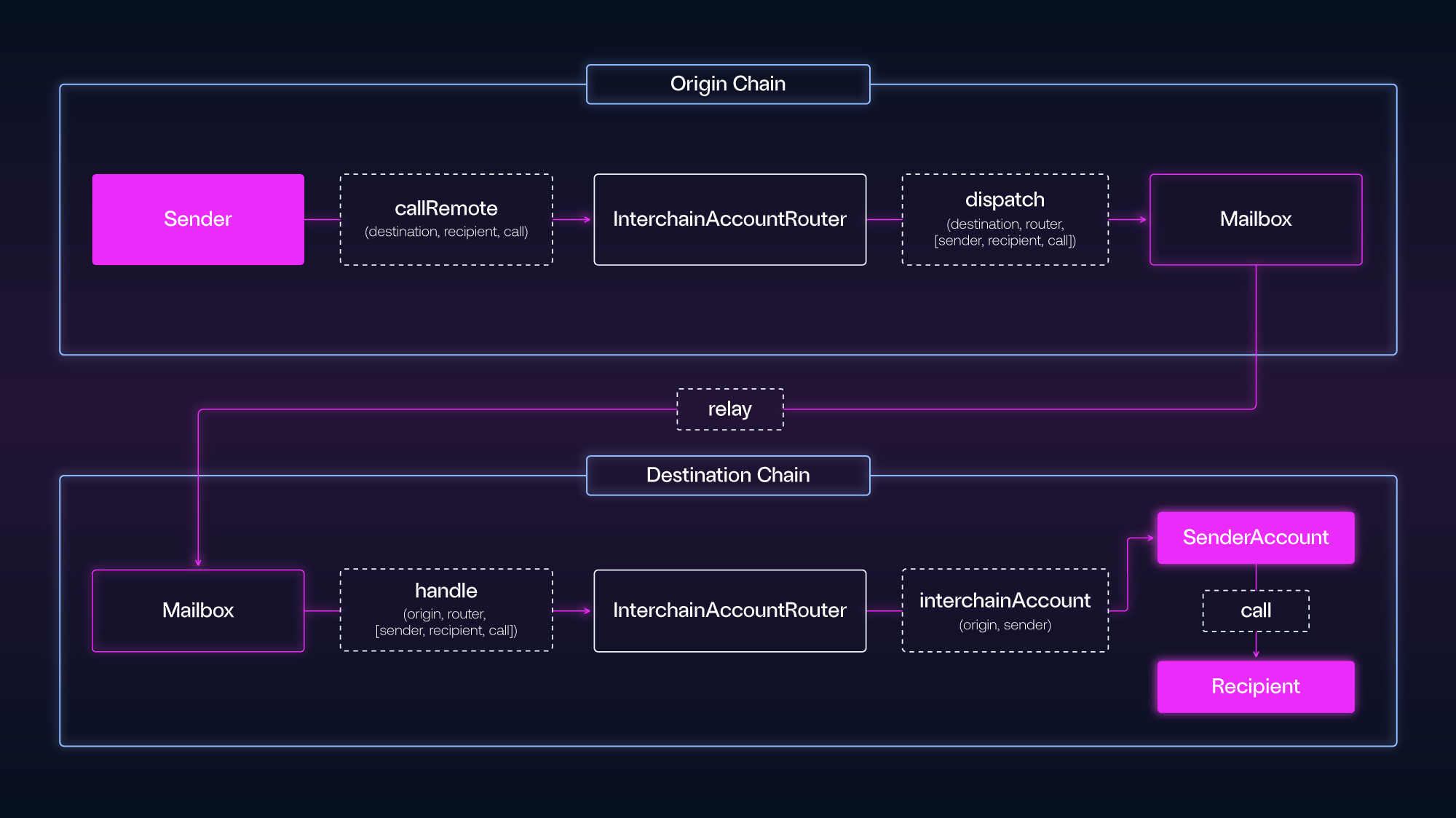
Here's how it works:
- You have a contract (the “sender”) on Chain A.
- You want it to make an authenticated call on Chain B (like executing a swap, minting an NFT, or interacting with DeFi).
- With ICAs, Chain A’s contract controls an account on Chain B. This account has a deterministic address based on the origin chain, sender and the Interchain Security module (ISM), which is the modular security component used to secure messages on the remote chain. The crucial part here is that each
(origin chain, sender)pair maps to its own unique account. This lets contracts on Chain B to identify the caller which is critical for functions that depend on authentication. - When you make a call, the Relayer relays the message across chains, and the ICA on Chain B executes the call.
This feature allows for cross-chain execution. Not just sending tokens or passing data, but actually using contracts on remote chains as if they were on the origin chain.
This makes building multi-chain apps way simpler.
ICA Example: Superswaps
Superswaps developed by Velodrome shows ICAs in action. Simply put, Superswaps is a cross-chain swapping mechanism that enables one-click token swaps across Superchain ecosystems using Hyperlane's interoperability stack.
.png)
In the Superswaps flow, the ICA receives bridged funds and performs the actual swap on the user’s behalf.
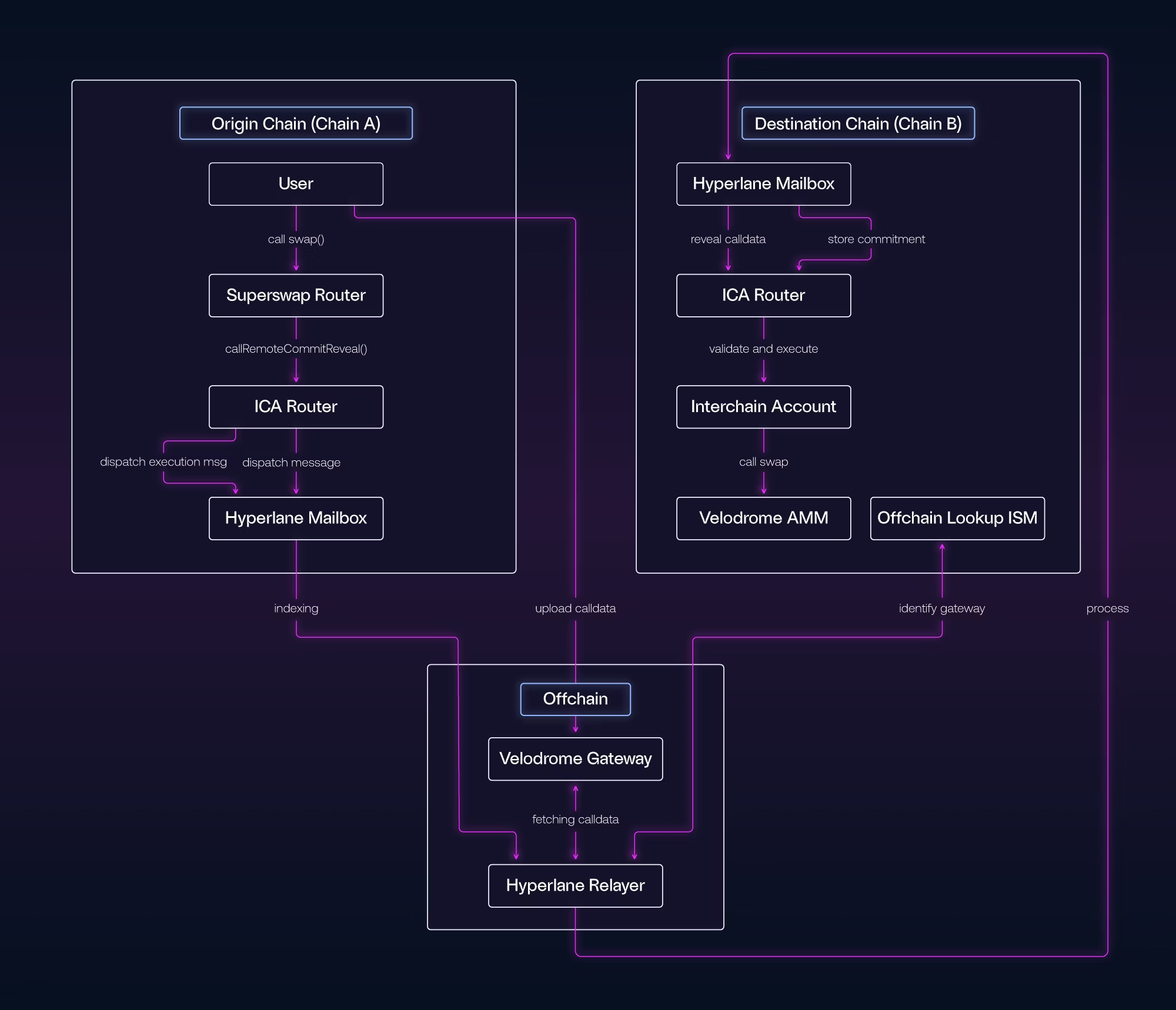
Here’s how Superswaps work under the hood:
- When a user initiates a Superswap, their tokens are first converted into oUSDT and bridged via Hyperlane Warp Routes (HWR) to their ICA on the destination chain.
- Meanwhile, the swap instructions are committed onchain only as a hash, keeping the details private until the reveal step.
- When the reveal message arrives, Hyperlane’s Offchain Lookup ISM verifies that the full swap data matches the earlier commitment.
- At that point, the ICA executes the swap on the destination chain using the bridged oUSDT, delivering the user’s target token.
ICAs are critical here because without them there would be no account on the destination chain that would be able to hold the bridged tokens and execute the final swap. In other words, without ICAs, Superswaps would still require separate contracts or manual steps.
ICA Architecture Overview
This diagram shows how ICAs work within Superswaps:
👉 Read more: https://docs.hyperlane.xyz/docs/applications/use-cases/cross-chain-swaps
Conclusion
Superswaps is one example of what Interchain Accounts (ICA) make possible. By giving contracts a ready-to-use account on remote chains, ICAs turn multi-step, fragmented workflows into one-click experiences.
ICAs aren’t limited to swaps. The same pattern applies to governance, collateral management, rollup withdrawals, or any use case where logic on one chain depends on action on another.
To put it all together, ICAs are essentially remote wallets your contracts control. Whether you’re building DeFi apps like Superswaps, NFT platforms, or protocols that need to span multiple chains, ICAs give you the building blocks to build powerful functionality.
More about Hyperlane
Hyperlane is the open interoperability framework. It empowers developers to connect anywhere onchain and build applications that can easily and securely communicate between multiple blockchains. Importantly, Hyperlane is fully open-source and always permissionless to build with.
Website | Docs | Twitter | Discord | Careers
Further Reading
.png)
July 8, 2026
Introducing Metastable: 1:1 Stablecoin Clearing
Metastable is stablecoin clearing infrastructure for 1:1 stablecoin conversions across any stablecoin and any blockchain. Deposit any stablecoin and get your desired stablecoin out. Abstract away the multi-stablecoin experience. With Metastable, a dollar is a dollar.
By

NoSleepJon

April 15, 2026
Introducing Predicate Hooks: Compliant Bridging on Hyperlane
Predicate is now available as a Hook on Hyperlane Warp Routes. Any chain on Hyperlane can now require compliance verification — KYC, sanctions screening, geo checks — before a single token leaves the origin chain. Compliant users get a normal bridging experience. Non-compliant transfers are stopped before anything moves.
By
NoSleepJon
.png)
Connect With Hyperlane
Hyperlane-as-a-Service
Get in touch to learn how we can facilitate a Hyperlane deployment specific to your needs.
Newsletter
Subscribe for monthly
updates on Hyperlane