19 March 2025
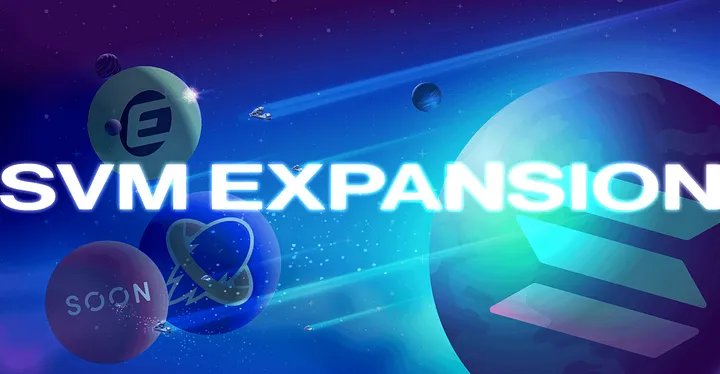
The State Of SVM Expansion
The State Of SVM Expansion

Paul Timofeev
Summary
2 years ago, Hyperlane was deployed on Solana. Since then, it’s processed over $600m in volume and reached 4 SVM chains. Here’s the latest.
2 years ago, Hyperlane was deployed on Solana, expanding beyond the Cosmos and EVM for the first time. Since then, it’s processed over $600 million in bridging volume across 400k+ messages in and out of Solana, as Hyperlane’s open interop framework has become essential infrastructure for teams building on the SVM. With fast bridging, asset issuance, and cross-chain messaging — Hyperlane helps builders bring the power and performance of the SVM to new chains and ecosystems.
If it’s SVM, Hyperlane is there.
From Solana → SVM Expansion
Solana, the second largest blockchain ecosystem, is known for its speed and performance. Users enjoy its fast, cheap transactions, which allow developers to build scalable, high-performance applications. A key component driving this performance is the Solana Virtual Machine, or the SVM.
The SVM is Solana’s execution environment — the place where all its transactions are processed and executed. What makes it unique from other VMs like the EVM is that it handles multiple transactions at the same time, or in parallel. This efficient design helps deliver the fast execution (400 ms) and high throughput (~900 TPS) Solana is known for today.(Read more about the SVM here.)

For years, the power and performance of the SVM was limited to Solana. Today, builders are bringing its capabilities to new chains and ecosystems.
Powering SVM Expansion
Fast forward to today, and SVM expansion is accelerating. Not only are builders extending the SVM, they’re doing so in unique and different ways. Some SVM chains settle to Solana; others to Ethereum. Some choose to charge gas fees in SOL or ETH, while others use their own native token.
Yet no matter how SVM chains are built, they all need a way to connect to the rest of the growing multichain world. They need a way to onboard new users, assets, and developers — that’s where Hyperlane comes in. From fast bridging to multichain token issuance and cross-chain messaging, Hyperlane is connecting the growing SVM ecosystem, chain by chain.
Here’s a look at the top teams leading SVM expansion today.
Eclipse
Eclipse Mainnet is a general-purpose SVM L2. It uses the SVM to execute transactions, Ethereum to settle transactions, and Celestia for storing transaction data. Launching on mainnet in November, Eclipse was the the first chain to adopt the SVM outside of Solana.

By building on the SVM, Eclipse delivers fast transactions at low costs ($0.0001 on average), making it well-suited for high-performance applications. This is demonstrated by the high throughput that Eclipse handles, seeing anywhere between 2–3K transactions-per-second (TPS) on a regular basis.

Today, most of this activity is driven by Turbo Tap, a tap-to-earn game where taps are processed as transactions on the L2. The game has helped demonstrate the scale of user activity and demand that Eclipse can handle, a testament to its performant L2 architecture and the parallel execution of the SVM.
Since mainnet launch, Eclipse has:
- Processed over 16 billion transactions in total. For reference, thats already nearly 4% of Solana’s total transaction count (383 billion+).
- Processed over $880 million in DEX volume.
- Generated over 860 ETH in fees.
Hyperlane has been there to support Eclipse from day one:
- Fast asset bridging across multiple ecosystems: Users can bridge in and out of Eclipse from Solana, Ethereum, and Stride.Warp Routes for SOL, USDC, USDT, ezSOL, ORCA, WIF, JitoSOL, kySOL, apxETH, wBTC, tETH, wETH, TIA, stTIA are live on Nexus.
- Multichain token issuance: Hyperlane powers TurboETH (tETH), the first unified restaking token. tETH is a Warp Token minted on Ethereum and bridged to Eclipse through Hyperlane. Today, over 8.7k tETH has been minted across 113k+ holders.
- Over $580 million has been bridged in and out of Eclipse using Hyperlane, accounting for over 80% of Eclipse’s total bridged volume.
*Data is from Eclipse Scan and State of Eclipse.
SOON
The Solana Optimistic Network (SOON) extends the capabilities of the SVM with two key innovations: SOON Mainnet and the SOON Stack.
SOON Mainnet is a high-performance L2 that settles to Ethereum and posts transaction data to EigenDA, while using the SVM for execution — but with a twist.

SOON builds on the Decoupled SVM, a new innovation designed to optimize the SVM for L2s. This approach removes features of the SVM that are essential for Solana mainnet — like voting transactions — but unnecessary for L2s like SOON.
This innovation allows SOON to generate new blocks based on user demand, rather than fixed block times. As a result, SOON is capable of generating new blocks as fast as 50ms (for reference, its 400ms on Solana today).
SOON Mainnet is also the flagship chain for the SOON Stack, a framework for building SOON Chains — scalable, high-performance L2s- with ease. By building on the SOON stack, developers get the performance benefits of the SVM, while maintaining flexibility around other parts of their chain, like settlement and data availability.
Since its mainnet launch, adoption of the SOON Stack has been growing as teams have been exploring new use cases to take advantage of the power and performance of the SVM:
- CARV — CARV is launching their CARV SVM Chain on the SOON Stack, combining the performance of the SVM with Ethereum’s security.
- svmBNB Chain- svmBNB is a SOON Chain that settles to BNB Chain, designed to bring the performance of the SVM to the Binance ecosystem.
- Both Cytonic and Lucent Network are building their first SVM chain on the SOON Stack.
From day one, Hyperlane has powered the SOON ecosystem with:
- Fast asset bridging between Solana and SOON: Users can bridge SOL and BONK between Solana and SOON in seconds on Nexus.
- Cross-Chain Messaging: Hyperlane is the underlying messaging layer for InterSOON, a cross-chain messaging protocol connecting SOON mainnet, the SOON stack, and other chains and ecosystems.
- Over $76 million has been bridged across 15.5k messages through SOON using Hyperlane as of today.
*Data is from the Hyperlane SOON Dashboard.
Sonic
Sonic is a new high-performance chain built with the SVM. It settles to Solana, uses SOL for gas fees, and natively runs Solana programs, making it the first chain extension on Solana.
Sonic is built on Hypergrid, a framework for deploying app-specific chains secured by Solana called Grids. Grids use the SVM for execution, though each grid comes with its own dedicated SVM. Transactions are ordered and processed by the Hypergrid Shared State Network before they are finally settled on Solana (read more about Hypergrid).

By adopting the SVM, Sonic is purpose-built to support high-demand use cases like gaming and entertainment. One key example of this is SonicX: a mini-app that links TikTok credentials to crypto wallets, allowing Tiktok users to access rewards and engage with onchain activities without leaving the app.
Sonic launched their Mobius Mainnet on February 27th, and Hyperlane has been there to support Sonic from day one:
- Fast asset bridging between Solana and Sonic: 7 Warp Routes currently available for SOL, SONIC, USDC, USDT, IrtsSOL, sSOL, and sonicSOL through Nexus.
Join SVM Expansion
By building with the SVM, developers can bring the power and performance of Solana to new chains and ecosystems. Whether its Ethereum L2s, custom app-chains, or new L1s altogether, one thing is certain — if it’s built on the SVM, Hyperlane will be there.
Are you an ambitious developer, founder, or researcher interested in building with the SVM?
⏩ Explore SVM Expansion: usenexus.org
⏩ Build with Hyperlane on SVM.
⏩ Reach out to build with Hyperlane.
More about Hyperlane
Hyperlane is the open interoperability framework. It empowers developers to connect anywhere onchain and build applications that can easily and securely communicate between 130+ blockchains. Importantly, Hyperlane is fully open-source and always permissionless to build with.
Further Reading
.png)
July 8, 2026
Introducing Metastable: 1:1 Stablecoin Clearing
Metastable is stablecoin clearing infrastructure for 1:1 stablecoin conversions across any stablecoin and any blockchain. Deposit any stablecoin and get your desired stablecoin out. Abstract away the multi-stablecoin experience. With Metastable, a dollar is a dollar.
By

NoSleepJon
April 15, 2026
Introducing Predicate Hooks: Compliant Bridging on Hyperlane
Predicate is now available as a Hook on Hyperlane Warp Routes. Any chain on Hyperlane can now require compliance verification — KYC, sanctions screening, geo checks — before a single token leaves the origin chain. Compliant users get a normal bridging experience. Non-compliant transfers are stopped before anything moves.
By
NoSleepJon
.png)
Connect With Hyperlane
Hyperlane-as-a-Service
Get in touch to learn how we can facilitate a Hyperlane deployment specific to your needs.
Newsletter
Subscribe for monthly
updates on Hyperlane